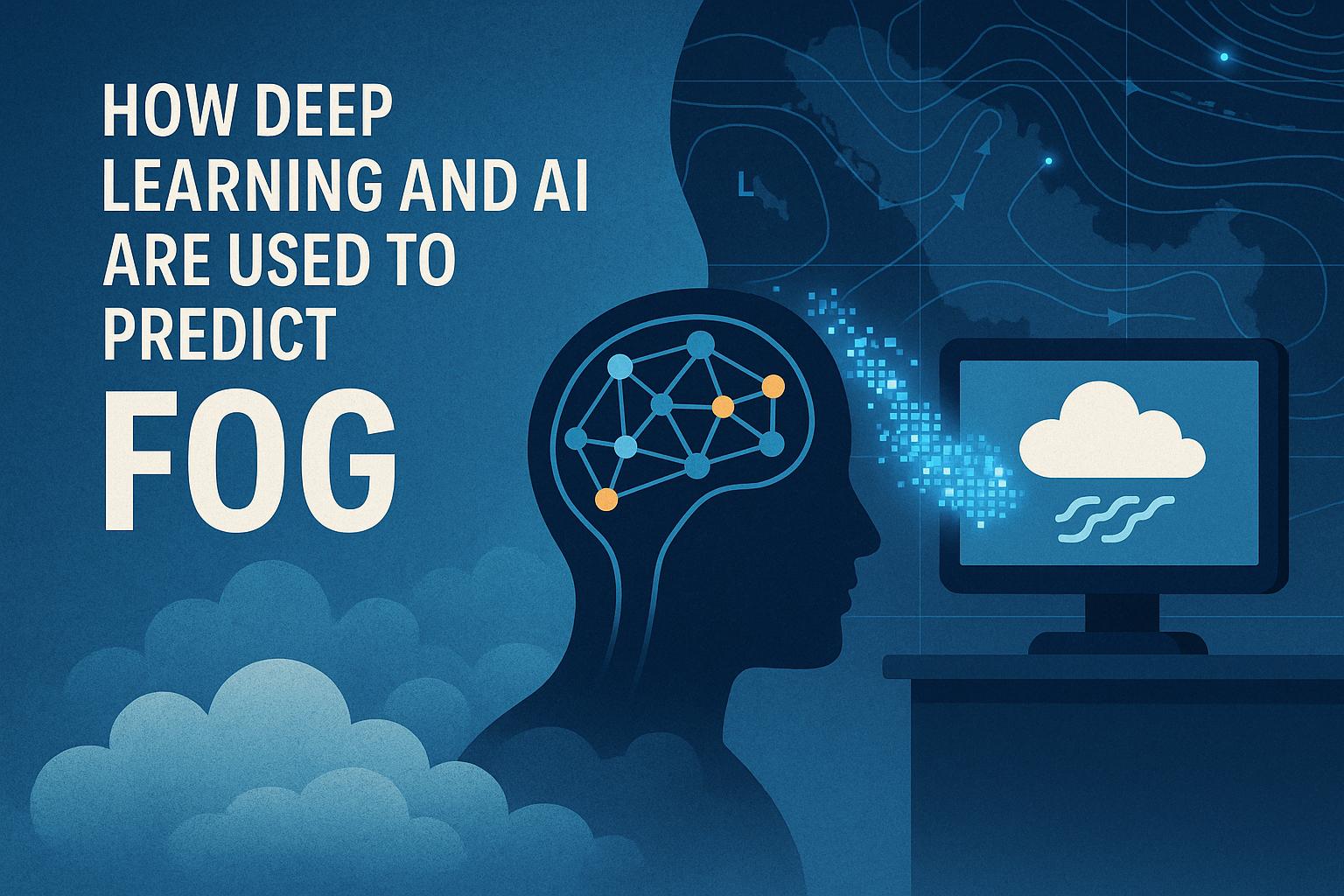
How Deep Learning and AI Are Used to Predict Fog
Introduction
In recent years, advancements in deep learning and artificial intelligence (AI) have led to significant improvements in weather prediction, including the ability to forecast fog. Fog, a complex weather phenomenon distinguished by the suspension of tiny water droplets or ice crystals near the Earth’s surface, poses significant risks in various sectors such as aviation, transportation, and agriculture. Accurate fog prediction is crucial for safety and planning. This article explores how deep learning and AI are being utilized to enhance fog prediction capabilities.
Understanding Fog Prediction Challenges
Fog prediction is a labyrinthine task primarily due to its localized nature and its multifaceted dependence on various environmental and climatic factors such as temperature, humidity, wind speed, and pressure. Each of these factors can vary significantly in short distances and time frames, making fog prediction exceedingly challenging. Traditional forecasting methods generally rely on synoptic climatology, which employs large-scale climate data to predict weather patterns. However, this approach often falls short in capturing the intricate local dynamics necessary for precise fog prediction. The limitations of traditional methods underscore the necessity for newer and more sophisticated approaches, such as those provided by AI and deep learning technologies.
Role of Deep Learning in Fog Prediction
Deep learning, a specialized subfield within machine learning, utilizes neural networks with multiple layers to model and understand intricate patterns within voluminous datasets. This capability makes deep learning exceptionally suited for weather prediction tasks, where analyzing vast quantities of meteorological data is essential to discern underlying patterns that affect the formation of fog.
Deep learning models are equipped to process both historical weather data and real-time data collected from various sources, including satellites, ground stations, and Internet of Things (IoT) devices. This extensive dataset allows deep learning models to learn and provide more accurate and timely fog forecasts. Such systems, therefore, not only improve current prediction capabilities but also potentially transform weather forecasting in the future.
Convolutional Neural Networks (CNNs)
Convolutional Neural Networks, originally developed for tasks in image recognition, have proven their effectiveness in fog prediction as well. These networks excel at analyzing spatial data relationships and are adept at processing satellite images and radar data. CNNs can extract meaningful features from visual data sets, contributing significantly to the prediction of both the onset and dissipation of fog. Their ability to interpret complex spatial patterns makes them invaluable tools in modern fog prediction efforts.
Recurrent Neural Networks (RNNs)
Recurrent Neural Networks, along with their variants such as Long Short-Term Memory (LSTM) networks, offer another avenue of advancement in fog prediction. RNNs are designed to manage and analyze sequential data, making them advantageous for weather prediction tasks requiring temporal insights. Their capability to capture temporal patterns within weather data positions them perfectly for predicting fog duration and frequency. This enables forecasters to make more nuanced and accurate predictions, aligning more closely with real-world conditions.
The Role of AI in Enhancing Fog Prediction
While deep learning provides the foundation for improved fog prediction, AI serves as a complementary force by integrating additional data sources and refining prediction models. AI systems employ data fusion techniques to mesh together different data sources like weather stations, satellite imagery, and vehicular sensors. This integrative approach significantly enhances prediction accuracy by offering a more comprehensive view of the environmental conditions that contribute to fog formation.
Reinforcement Learning
Within the realm of AI, reinforcement learning holds promise for further optimizing fog prediction. This type of machine learning involves models learning optimal actions through trial and error, enabling systems to improve prediction models continuously. By constantly adjusting parameters based on feedback from real-world data, reinforcement learning contributes to progressively more accurate fog forecasts. Its dynamic nature ensures that prediction models remain robust and adaptable in the face of changing weather patterns.
Applications and Implications
The ability to accurately predict fog has profound implications across various sectors. In aviation, precise fog forecasts enhance flight safety by informing routing decisions and reducing flight delays. Terror-inducing fog-related incidents can be minimized through better prediction, facilitating smoother airport operations. When it comes to transportation, accurate fog forecasting plays a critical role in preventing road and railway accidents by allowing for timely precautions and route adjustments. In agriculture, farmers benefit from better fog prediction as it aids in making informed decisions about protecting crops and livestock from adverse foggy conditions. Enhanced forecasting stands as a crucial component in the agricultural planning landscape, ensuring reliable outputs despite environmental challenges.
Future Directions
As deep learning and AI technologies continue to evolve, their application in fog prediction is poised to expand. Ongoing research aims not only at improving model accuracy but also at reducing computational demands and boosting real-time prediction capabilities. As models become more sophisticated, they hold the potential to further mitigate risks associated with fog. The continued advancement of these technologies promises to offer safer and more efficient operations across various industries affected by weather conditions, paving the way for future innovations in weather prediction and beyond.
For more information on the role of AI in weather prediction, you can explore resources from reputable institutions and organizations conducting innovative research in this field. These sources provide additional avenues for understanding the broader implications of AI and deep learning in forecasting not only fog but various other weather phenomena as well.