The Science Behind Fog Horns and How They Work
The Basics of Fog Horns
Fog horns play a crucial role in maritime navigation, a vital lifeline for seafarers traversing waters where visibility can drastically diminish due to fog. These robust devices are specifically engineered to emit sounds of significant intensity and clarity, effectively guiding ships and preventing potential collisions by alerting them to navigational hazards. The evolution of fog horn technology has seen these devices become an integral part of maritime safety protocols, with a foundation rooted in acoustics and technological innovation.
The Purpose of Fog Horns
The primary purpose of fog horns is to communicate warnings to mariners about the presence of potential navigational hazards. Through the strategic use of sound patterns, such as specific tones and intervals, ship captains can ascertain their proximity to coastlines, other vessels, or underwater hazards. By interpreting these auditory signals, mariners can make informed navigational choices, thereby enhancing maritime safety and reducing the risk of accidents.
Sound Propagation in Fog
The behavior of sound waves in foggy conditions differs markedly from how they travel in clear weather. The high moisture content of fog can actually enhance the propagation of sound, allowing it to travel greater distances with reduced distortion. This phenomenon occurs because dense air with high humidity tends to support the transmission of low-frequency sound waves more effectively than dry air. Fog horns are specifically tuned to take advantage of these atmospheric conditions, ensuring that their sound can reach ships far out at sea, alerting crews to nearby dangers well in advance.
The Science of Sound in Fog Horns
The effective operation of fog horns is based on the principle that low-frequency sounds are ideal for transmitting over long distances. Low-frequency sound waves, characterized by their long wavelengths, have a greater ability to travel in a straight line without scattering. This inherent property ensures clarity and consistency in the sound waves reaching the targeted listeners, even over vast expanses of open water. For a fog horn to be effective, it should generate sounds within a frequency range that leverages these acoustical advantages, allowing navigators to interpret signals clearly even under poor visibility conditions.
Types and Mechanisms
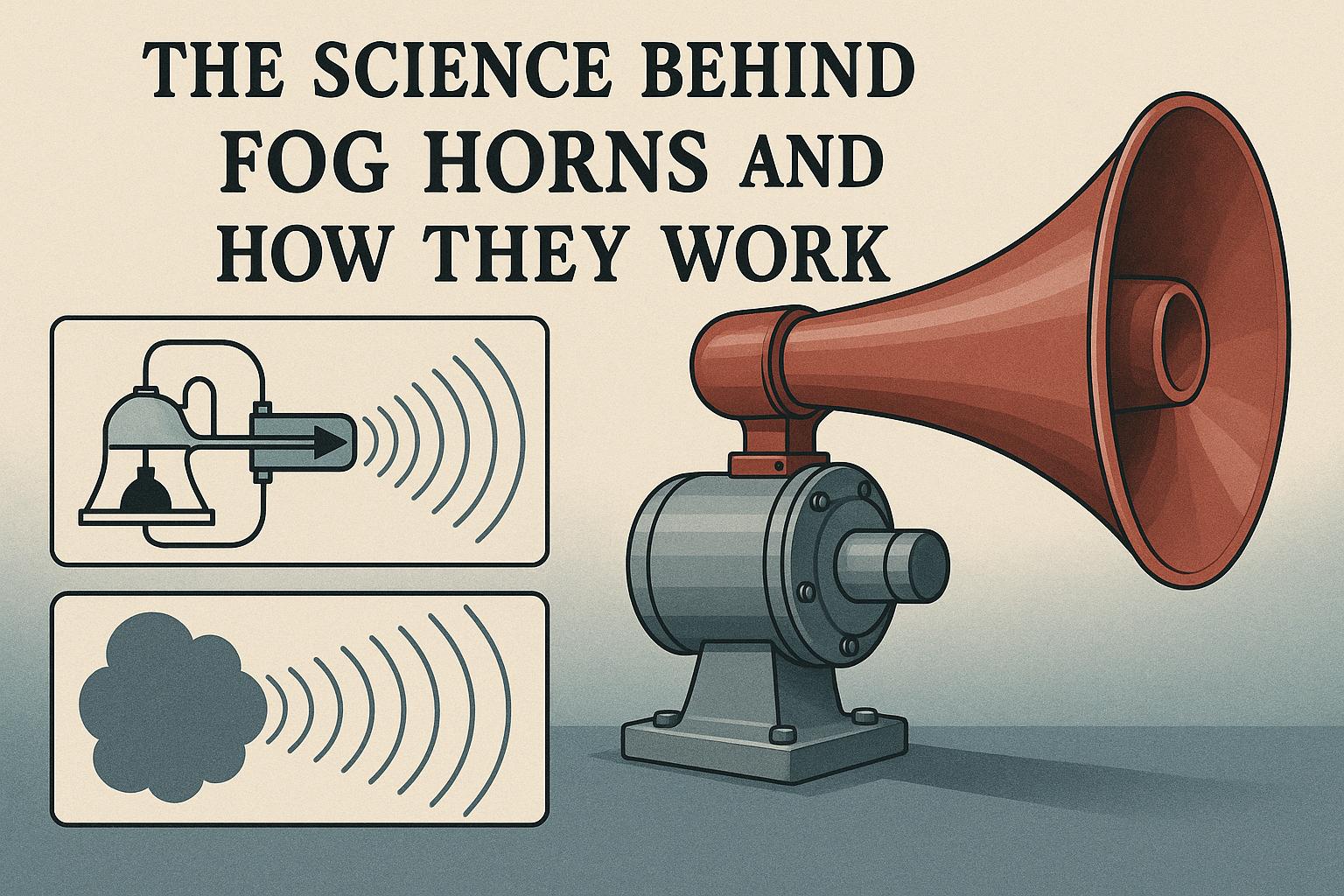
Fog horns have evolved in design and mechanism, transitioning from traditional mechanical forms to modern electronic iterations. Originally, fog horns were purely mechanical, operating on compressed air that was forced through horns to create sound. These classic fog horns produced distinctive deep, resonant tones that could cut through the ambient noise of the sea.
In contemporary settings, many fog horns have adopted electronic components, comprising speakers and amplifiers to replicate the familiar sounds of their mechanical counterparts. Regardless of the mechanism employed, each fog horn is crafted to produce a specific pitch and interval pattern. These unique acoustic profiles are vital for aiding mariners in vessel identification and location discernment, reinforcing the safety and efficiency of maritime operations.
Functionality of Fog Horns
Understanding the functionality of fog horns involves examining both the power sources and the transmission systems that facilitate their operation. In the context of mechanical fog horns, the process begins with compressing air, which is expelled through specialized components that vibrate to create sound. This diaphonic technique ensures both volume and tonal consistency. Meanwhile, electric fog horns employ speakers and amplifiers to recreate similar sound waves, leveraging modern audio technology to achieve desired acoustical effects. The implementation of waveguide systems, which channel sound in specific directions, helps optimize the reach and clarity of fog horn signals, further assisting mariners in navigation.
The Importance of Fog Horn Regulations
Given the crucial safety role that fog horns play in maritime environments, many governments, particularly those overseeing extensive maritime operations, have instituted regulations governing their use. These regulations address critical aspects such as the allowable volume levels, frequency ranges, and operational timing for fog horns, ensuring that they are effective without being intrusive to communities.
Compliance with these regulations ensures that fog horns serve their intended purpose without causing undue disturbances. Adhering to these standards is essential not only for the safety of vessels and their crews but also for maintaining harmonious interactions between maritime activities and the broader environment.
Conclusion
Fog horns remain indispensable components of maritime safety, exploiting the principles of sound science to navigate vessels through low-visibility conditions. Their role in coastal and onboard installations continues to evolve, as modern technology integrates into traditional practices to enhance both efficacy and reliability. Understanding the intricacies of fog horn operation, from sound propagation to regulatory considerations, equips maritime professionals with the knowledge needed for safe navigation. For those seeking deeper insights into maritime safety equipment, further resources are available to explore the expansive world of nautical technology and its applications.