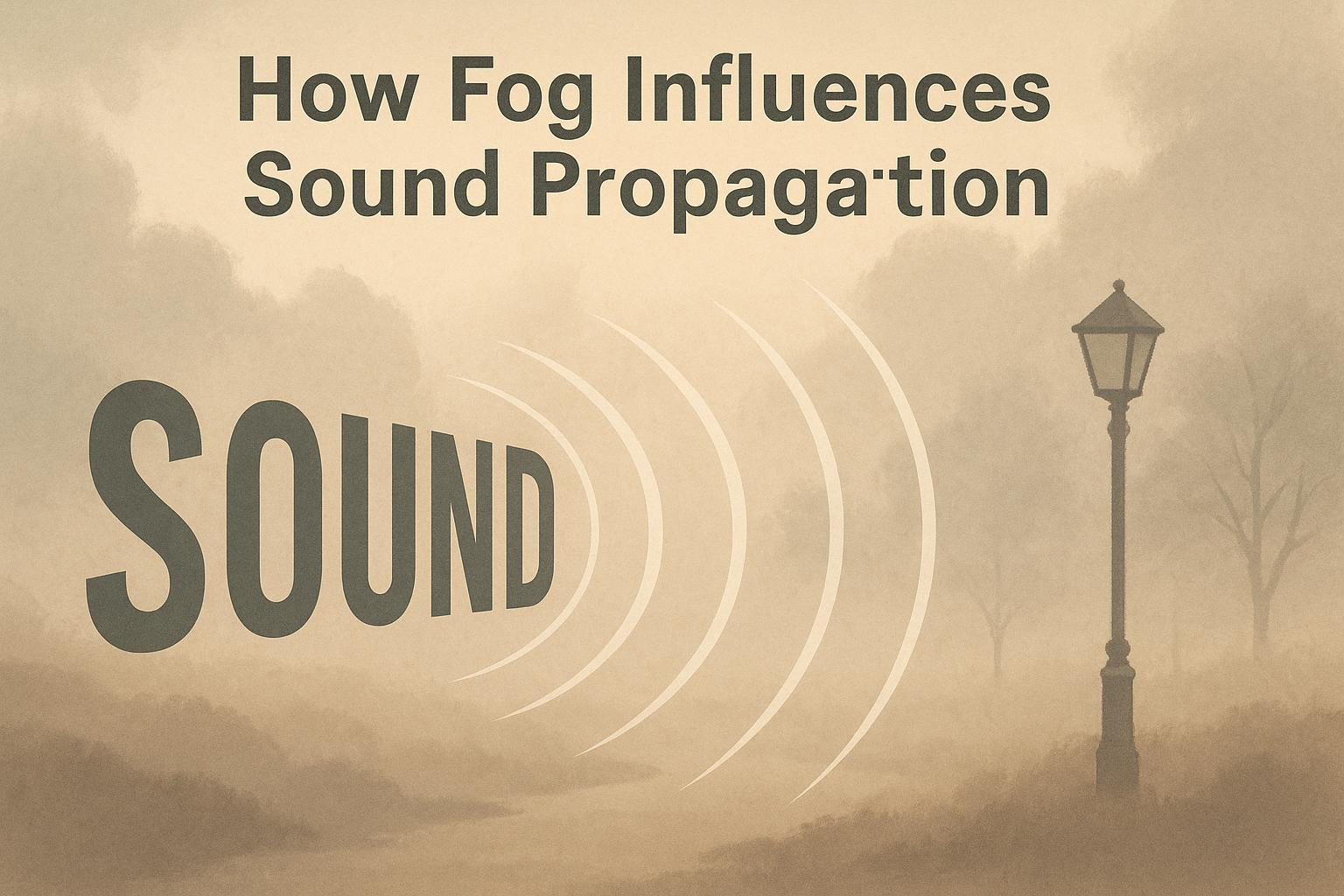
How Fog Influences Sound Propagation
Introduction to Sound Propagation in Fog
The phenomenon of fog is fascinating not only for its atmospheric mystery but also for how it affects the propagation of sound. When navigating through foggy conditions, you might notice sounds behaving differently than they do in clear air. Understanding this phenomenon requires delving into the physics of sound waves and how they interact with water droplets suspended in the air.
The Basic Principles of Sound Propagation
Sound travels through the air as pressure waves created by vibrating objects. These waves continue to propagate in different directions, creating areas of compression and rarefaction. When sound travels through a medium, such as air, its speed depends on the temperature and density of that medium. In foggy conditions, the presence of numerous small water droplets can significantly alter the characteristics of the medium.
Interaction with Water Droplets
Fog consists of countless micro-droplets of water, which scatter sound waves. Unlike clear air, which offers relatively nondisturbing paths for sound waves, foggy air introduces multiple interfaces for sound to scatter. The scattering occurs mainly because the size of the droplets is comparable to the wavelength of various sound frequencies. This interaction often leads to a damping or softening of sound as it travels over distances.
Effect on Sound Frequency
High-frequency sounds, which have shorter wavelengths, are more likely to be scattered by fog droplets. This means that in foggy conditions, higher-pitched sounds tend to lose energy more quickly than lower-frequency sounds. Consequently, lower-frequency sounds may travel farther and seem relatively unaffected, while high-frequency noises might become muffled.
Temperature Inversion in Fog
Another important aspect of fog that influences sound propagation is a temperature inversion. In a temperature inversion, warmer air sits above cooler air, which can occur often in foggy conditions. This layering can trap sound waves close to the ground, causing them to refract or bend back towards the Earth. As a result, sounds can become louder or more pronounced at certain distances, despite the dampening effects of the fog.
Practical Implications and Observations
For those navigating through foggy environments, understanding these principles can help in assessing the situation more accurately. Mariners, pilots, and drivers often need to rely on auditory cues in low-visibility conditions. Recognizing that sound patterns might shift during foggy conditions helps in making informed decisions.
Acoustic Navigation in Foggy Conditions
In foggy weather, visual cues are severely limited, compelling navigators to rely more on auditory signals. Ships, airplanes, and even cars must adapt their operational protocols accordingly. For instance, maritime vessels often use foghorns to broadcast their position and alert other ships of their presence. The effectiveness of these signals depends heavily on an understanding of how sound propagates in fog. Similarly, aircraft may adjust their approach angle or operational altitude to accommodate the changes in sound behavior due to fog. Drivers, on the other hand, might become cautious when using horns or paying attention to engine sounds to gauge distances and the presence of other vehicles in close proximity.
Effects on Animal Behavior
Fog can also impact how animals communicate and navigate. Many animals rely on sound for communication, and their ability to do so effectively can be hindered by fog. Birds, for example, may alter their calling patterns in foggy conditions. Marine animals, such as dolphins and whales, which use echolocation, must also adjust to varying conditions that affect sound propagation in water. Understanding how fog impacts sound can provide insights into wildlife behavior and help in conservation efforts.
Technological Applications
The knowledge of how fog affects sound propagation can be applied to various technological domains. For instance, sonar technology, used in underwater exploration and navigation, takes into account the significant impact water droplets have on sound waves. Engineers and technologists develop equipment designed to cope with the challenges presented by fog. Innovations such as improved sonar systems, radar technology, and navigational aids continue to advance, thanks to our understanding of sound propagation in fog and analogous conditions.
Challenges in Communication Systems
Communication systems often face significant challenges in foggy conditions, particularly those relying on acoustic signals. The scattering and dampening of acoustic waves can lead to noise interference and signal loss, affecting communication reliability. Engineers strive to design more robust communication infrastructures capable of adapting to various atmospheric conditions, including fog, to maintain signal clarity and efficiency.
Implications for Safety
In environments where human safety is paramount, the implications of altered sound propagation during foggy conditions cannot be overstated. Sectors such as aviation, maritime navigation, and road transportation place significant emphasis on training and technological innovations that allow individuals to respond effectively to the auditory changes that fog induces. Safety measures, enhanced by technological tools and an understanding of sound dynamics in fog, contribute to minimizing accidents and enhancing situational awareness.
Research and Future Directions
Ongoing research continues to explore the phenomenon of sound propagation in fog. Scientists are interested in quantifying the precise ways in which fog alters sound, measuring the degree to which sound frequencies are dampened or refracted. Future research may focus on developing predictive models that anticipate how fog may impact various environments. Advances in computational acoustics and atmospheric physics hold promise for further breakthroughs in this fascinating domain.
Environmental and Climatic Considerations
Climate change may contribute to alterations in fog patterns and frequencies, potentially affecting sound propagation techniques and applications. Understanding these changes can help societies adapt to evolving climatic conditions, maintaining efficient communication and navigation in the face of new environmental challenges. The broader implications for ecosystems and atmospheric sciences render this field a critical area of study for future sustainable development.
Conclusion
Understanding how fog influences sound propagation enriches our broader comprehension of atmospheric phenomena. The complex interplay between sound waves, fog, and environmental conditions underscores the importance of continued research and pragmatic applications. From enhancing safety measures to better understanding animal behaviors, studying sound propagation in fog offers valuable insights into the natural and technological world. As we deepen our grasp of these dynamics, the potential for innovation and adaptation continues to grow, influencing various industries and research domains that can benefit from these insights in the years to come.